


Tarot de Marseille — New Luxury Edition
- Year
- 2024
- Client
- Grimaud Paris
- Agency
- Goodpeoplewander
- Agent
- Folio Art
Tarot de Marseille — New Luxury Edition
- Year
- 2024
- Client
- Grimaud Paris
- Agency
- Goodpeoplewander
- Agent
- Folio Art
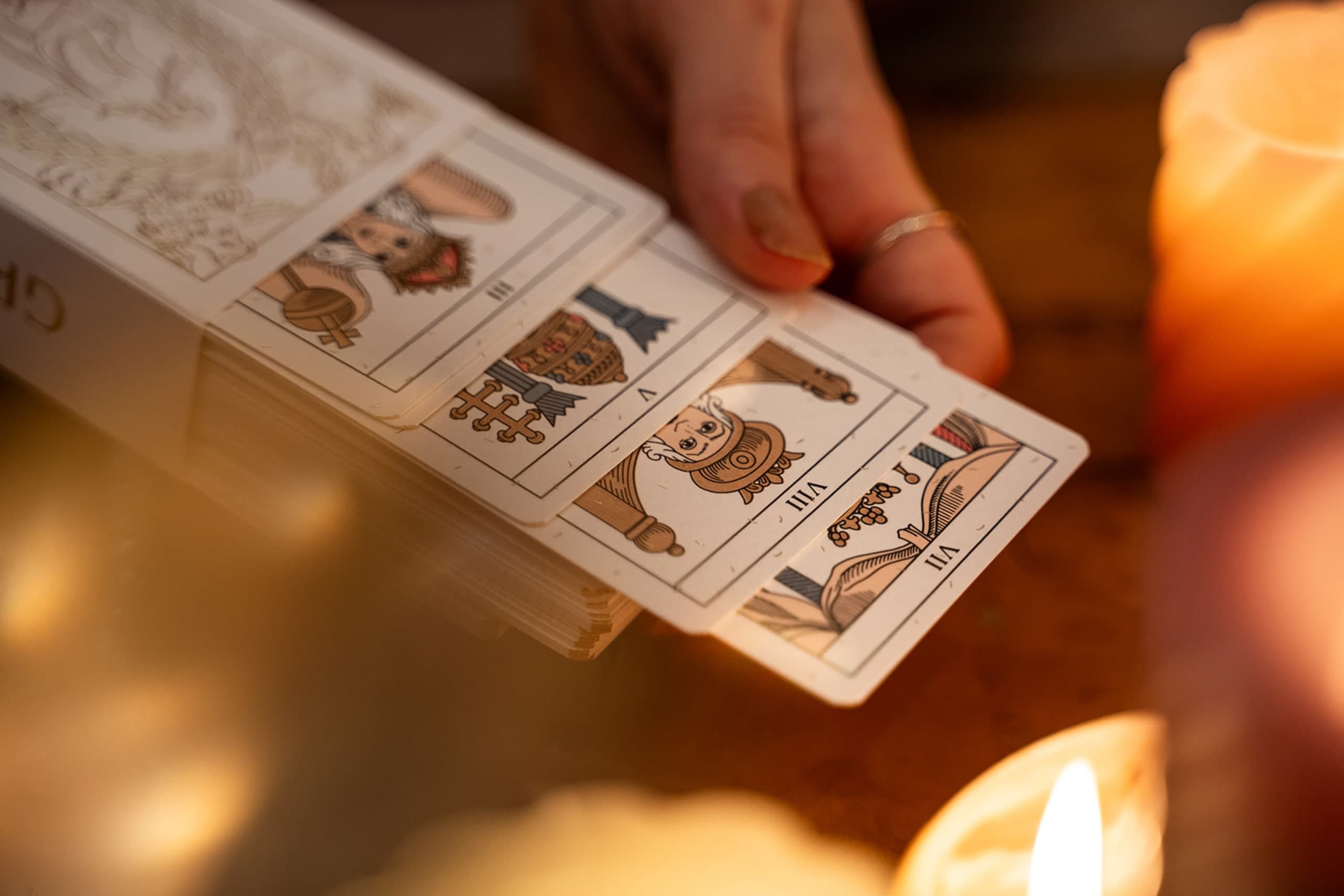
78 cards redrawn by hand and vectorised from 18th-century archive decks held at the BNF. For the 2024 relaunch of Grimaud Paris, via Folio Art.
A Luxury Edition of the Tarot de Marseille
Grimaud Paris, a card-making house founded in 1848 and acquired by Cartamundi in the 1990s, relaunched in 2024 as a brand of luxury gaming objects. The Tarot de Marseille N°400 sits at the core of that relaunch.
Grimaud's tarot heritage runs deep: the house acquired the Tarot d'Arnoult — created in 1748 — in 1891, and Paul Marteau redrew it in 1930. The new edition continues that line. Creative direction was led by the agency GoodPeopleWander — identity overhaul, illustrator curation, packaging — and the studio was chosen for the tarot.
Renewing without reinventing
We worked from 18th-century decks — some held at the Bibliothèque nationale de France — softening the lines, neutralising the figures, lightening the palette, without erasing the structural memory of each card.
Laetitia Barbier, a specialist in cartomancy and art history, brought guidance that was light but decisive. Less a strict iconographic supervision than an attention to the symbolic weight of each card — letting it breathe without overloading it with a contemporary hand.
Seventy-eight cards, drawn by hand then vectorised
Each card was redrawn by hand, colourised, then fully vectorised. The process runs across all 78 cards — 22 major arcana and 56 minor in four suits (cups, swords, wands, coins) — with no shortcut. The original structure of each composition is preserved: the eye finds the tarot it knows. It is the details that shift: a less angular line, a figure rendered less gendered, a slightly raised tone.
Eight colours carry the whole deck, plus a gold-foil pass. Each was chosen to hold with the other seven — a matter of palette as much as of line. Direct tones, far from the standard four-colour process, let each shade be tuned as close as possible to the original references.
Restraint as a stance
The tension of the project lives in the constraint: 78 compositions already known, already charged, where every departure from tradition has to justify itself. Drawing to accompany rather than to sign demands a restraint that barely shows. That is precisely the point. The deck has to look as though it always looked this way.
It is probably the hardest gesture to draw: the one you don't see.
The printed object
For the final edition, Grimaud Paris printed the cards on 350g black-core casino-grade stock, in ten colours, with cold-foil and hot-stamping at the corners and on the faces. The varnish, plastic-free, is built for durability. The box was produced by Créanog, a Parisian workshop in the Bastille district, on bespoke crafted paper — it holds the card sleeve and a 141-page booklet written by Laetitia Barbier, in which she sets out the meanings and interpretations of the arcana.
Distribution
The edition retails at €280, distributed at Le Bon Marché Rive Gauche in Paris, Harrods in London, and El Corte Inglés in Spain.
”The collaboration was seamless, the work refined and delicate, honouring the deck's heritage while bringing a modern touch to the artwork.”
Credits
- Client
- Grimaud Paris
- Agency
- GoodPeopleWander
- Creative Director
- Loïc Le Bihan
- Client Director
- Laure Barbier