
Two objects — two approaches. A black wooden casket with gilded hinges, made for a single bottle that will be opened slowly. A champagne giftbox produced at scale, that will pass through tens of thousands of hands during six weeks of festivities.
When illustrating for spirits houses, it's rare for two commissions to resemble each other — and it's almost never a question of greater or lesser prestige. It's a question of approach, and each approach imposes its own rules.
Two recent projects, a few months apart: an 80 Year Old Tawny Port casket for Graham's, produced in six hundred copies worldwide, and the limited edition Moët Impérial giftbox for the end-of-year celebrations, printed in over two hundred thousand. Here's what each one asked of us.
Graham's Port — reading a product
The commission came to us through Folio Art, our agent in London. The deliverable: a botanical illustration to line the interior of a black varnished wooden casket with gilded hinges, designed to hold a single bottle — a Tawny aged eighty years in cask, each copy trading at around two thousand euros. The thematic thread set by the brief: long-lived species. Oak, olive, chestnut.
Six hundred bottles worldwide. Around a hundred for the British market, a few dozen per country elsewhere. At that scale, the bottle won't be grabbed distractedly off a shelf — it will be received, opened slowly, contemplated. Every square centimetre of the drawing will be looked at closely, and no visual shortcut is permitted.
The reference set the client provided pointed in a direction we often hear for this kind of age statement: midnight-blue grounds, nocturnal density, dark depth — the intuitive imagery of long time, of cellars and archives. We proposed the opposite, and we defended it — not as an aesthetic preference, but by reading what was actually in the bottle.
Representing this ageing through midnight blue would have been a metaphor — the archive, the cellar, the long night of time. Representing it through ambers, golds and autumn browns, on a deep earth-brown ground, was simply showing the depth of the wine.
At the heart of the assemblage are wines set aside in 1941 and 1942, at a moment when the war had closed Port's export market. Eighty years in cask later, sixty-four percent of the original liquid has evaporated through the wood. What remains are the molecules that have travelled through eight decades of concentration — and their optical signature is not darkness, it's the amber robe with copper highlights of aged Tawnys, what oenologists call the mahogany colour tending towards gold.
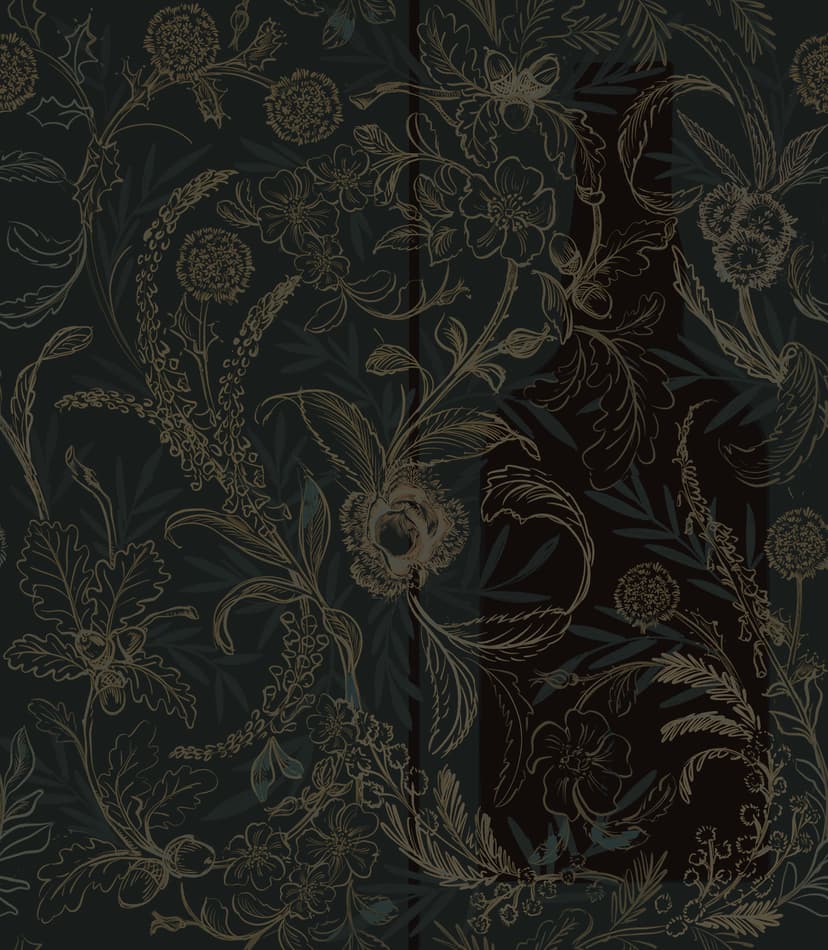
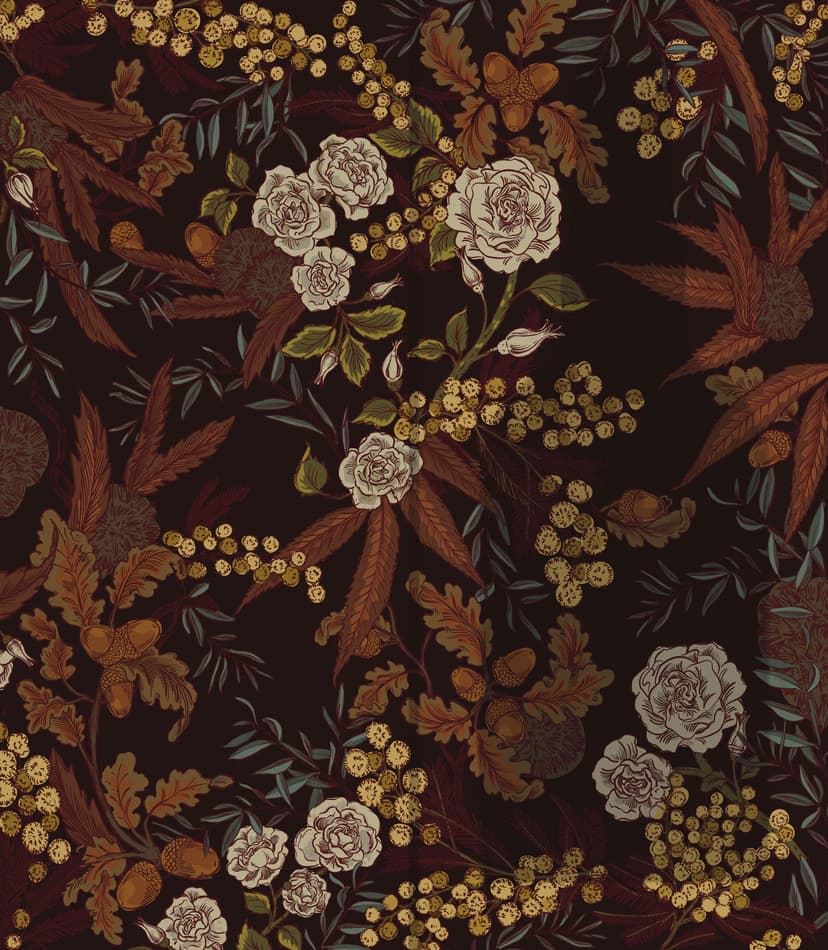
The rendering has nothing of an engraving about it: it's botanical illustration in colour, in the lineage of nineteenth-century plates, with modelling and cast shadows. Every leaf carries its veins, every chestnut its downy burr, every rose its rose-and-copper gradients. This level of detail is where the real work sits: a drawing that has to reward the eye that comes close, without ever becoming illegible from a distance.
The composition follows a bouquet logic, not a grid — a structural choice, not an aesthetic one. A pattern organised around a central focal point cannot tile a volume; a pattern without a centre, built on even density, can be cut anywhere. Structuring foliage first — oak, olive — then high-presence elements: chestnut, mimosa, rose. Finally, branches with acorns and rosebuds fill the gaps.
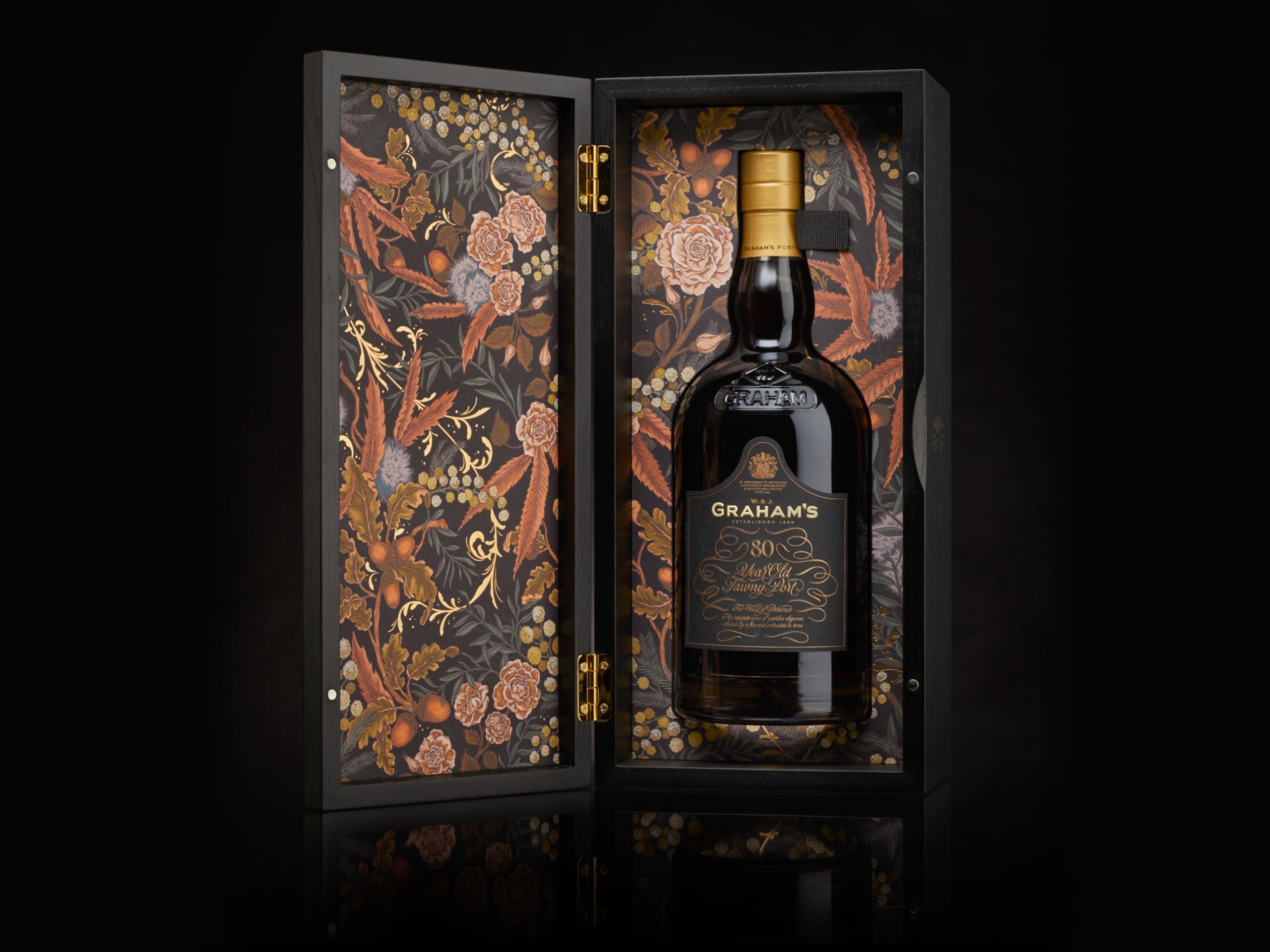
Over this polychrome illustrated base, ornamental scrollwork in hot gold foil is layered as an overprint — a precious accent that appears and disappears depending on how the casket is lit. The file is drawn on iPad and vectorised in Illustrator, with each botanical element delivered on a separate layer.
This segmentation wasn't requested. We did it because it seemed likely the house would later want to animate these leaves and flowers for digital use. Delivering a file already prepared for that purpose avoids a manual separation step down the line, and signals that we've read the brand's wider ecosystem beyond the immediate deliverable.
Moët & Chandon — reading a programme
A few months later, through the agency NR2154 and our agent Kajsa at Agent & Artists, we were selected at the end of a pitch against five or six Parisian agencies and illustrators: the limited edition Moët Impérial giftbox, end-of-year 2024, with a wallpaper extension for the house's Christmas events.
Print run of over two hundred thousand. At that scale, the pressure changes nature. The giftbox won't be contemplated — it will be seen quickly, on a supermarket shelf or a reception table, and the house's visual decisions will play out under entirely different conditions, on every continent. A jarring detail creates thousands of jarring boxes. A poorly proportioned element becomes a multiplied nuisance. The work consists in designing an object that can take massive duplication without losing its rightness.
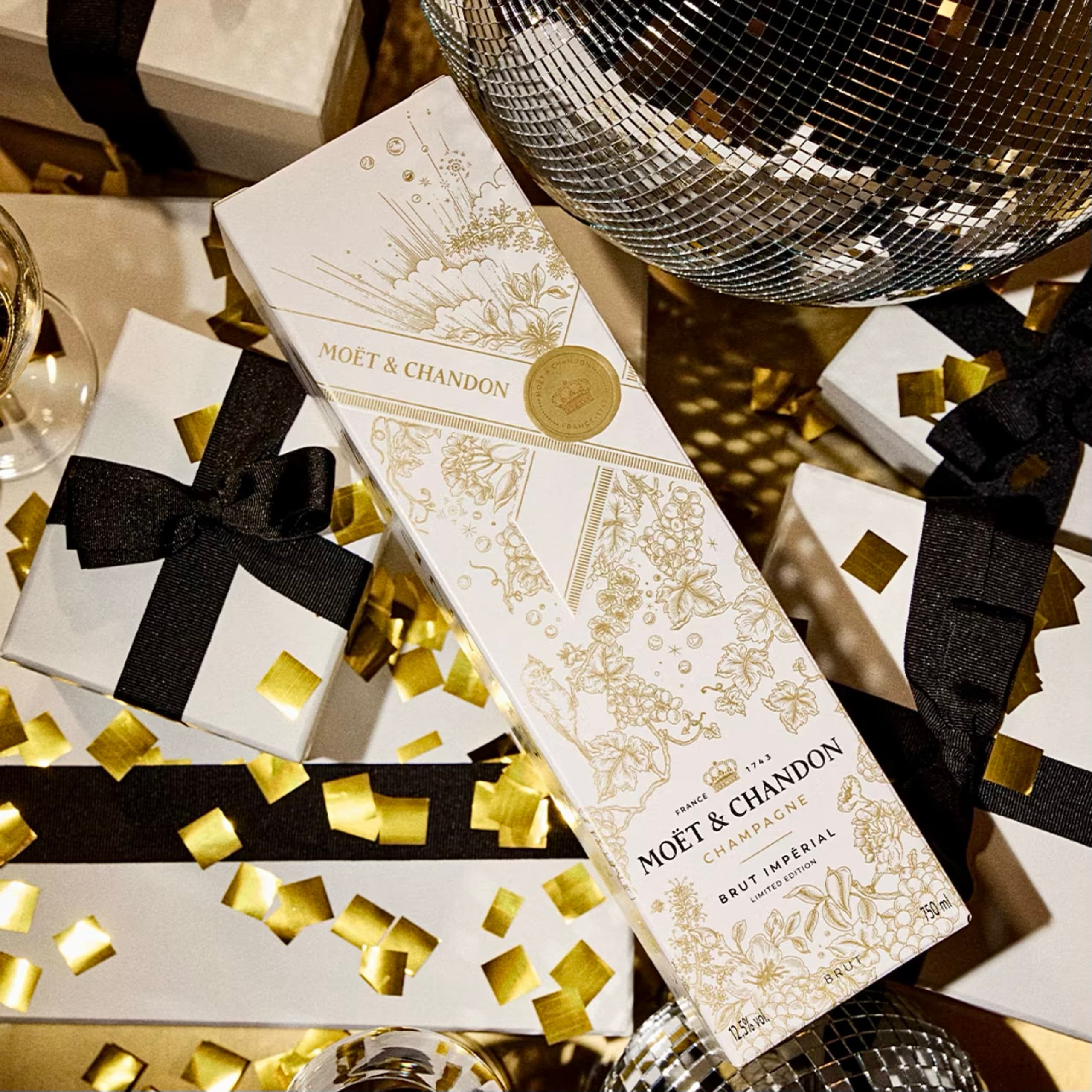
The graphic equation comes down to three fixed elements: logo, medallion, sash — the gold dotted band that wraps the bottle, to be kept untouched. We proposed several versions where vine shoots crossed the sash to absorb it into the weave, in the manner of a baroque Dior canvas. The house, attached to the legibility of this branding element, preferred to leave it intact.
What remained to be resolved became more subtle. Sash and motif share the same material — hot gold foil — so the contrast separating them isn't chromatic, it's geometric. A clean band laid over a teeming organic weave. For the sash not to look like a label stuck on top, but like a band that belongs to the image, you have to think about how the masses circulate around it.
The motif itself is built around a measured arbitration: roughly eighty percent vines, grapes and leaves, twenty percent fauna and flora. The content of those twenty percent isn't decorative. It's drawn from the house's Natura Nostra programme, the agroecology plan launched in 2021 that commits Moët to creating one hundred kilometres of ecological corridors across the Champagne vineyard — an objective already at the halfway mark by the end of 2024. The motif incorporates the species this programme protects, distributed through the weave alongside a few tasting notes.

The ratio wasn't invented. At sixty-forty, the motif would have tipped into ecosystem inventory. At ninety-five-five, the biodiversity commitment would have become invisible again — a symbolic mention rather than a real presence. Twenty percent is what the weave can hold without ceasing to be a viticultural motif, and it's enough for the programme to exist to the eye. The proportion is the argument, but the argument comes from the house, not from the studio.
The composition is vertical and narrative. At the top of the box: a cork popping, an explosion of bubbles, a cloud and stars — a scene. In the middle: the sash and the medallion. At the bottom: the dense botanical weave that descends around the name of the house. It isn't a uniform wallpaper — it's a visual story that guides the eye from festive sparkle down to botanical anchoring.
Two versions were presented to the client, given equal standing — we didn't push the more demonstrative one. Restraint served the final reading better, on packaging already loaded semantically by the logo and the medallion.


The whole illustration is drawn in monochrome line, with no flat colour or gradients, and printed in hot gold foil on a white ground.
Hot foil stamping — one technique, two uses
Both projects use the same printing technique: hot foil stamping, where a sheet of metal foil is applied under pressure to transfer the metal onto the substrate. They use it in opposite ways.
On Moët, the foil is the motif. Everything you see in gold — vines, stars, sash, exploding cork, the name of the house — comes out of the same printing operation. The monochrome line drawing isn't a stylistic stance: it's an answer to the industrial constraints of the print run. A line motif vectorises directly, adapts without friction to foil stamping at large scale, and extends to large-format wallpaper without any rework. One technical pass for two hundred thousand copies.
On Graham's, the foil completes the motif. The base is printed in four-colour process; the gold scrollwork is layered on top as an overprint — an extra pass that only appears at certain angles of light. It's the opposite of economy: an accumulation of printing operations in the service of a rare object.
Same technique, two uses. Six hundred copies on one side, two hundred thousand on the other — and the foil shifts from a final, almost calligraphic stroke, to the entire skeleton of the motif.